
Understanding the Key Differences: Piano vs. Keyboard
In the world of music, instruments are often compared to discern their unique characteristics and abilities. One such comparison often revolves around two popular instruments: the piano and the keyboard.
Today, we'll delve into answering the question, "What is the difference between piano and keyboard?" This examination will aid in understanding the distinctive traits of both, thereby providing clarity for potential players and music enthusiasts alike.
The purpose of this article is twofold. Firstly, we aim to dispel common misconceptions surrounding pianos and keyboards, eradicating any confusion between the two. Secondly, we strive to underscore the unique attributes and peculiarities inherent to acoustic instrument and keyboard.
By presenting detailed, accurate information, we hope to guide potential players and music aficionados in their understanding and appreciation of these popular instruments.
Historical Overview
The Piano: Origins and Evolution
The piano, an abbreviation of 'pianoforte', traces its roots back to the early 18th century. Its creation is credited to Bartolomeo Cristofori of Padua, Italy, who was an expert harpsichord maker. Cristofori was striving to create an instrument that offered greater control over dynamics compared to the harpsichord, and in doing so, he invented the piano around 1700.
The piano underwent significant evolution over the centuries. In the 19th century, the iron frame was introduced, which allowed it to withstand the high tension of strings, thereby expanding its tonal range. The modern piano, as we know it today, boasts seven octaves plus a minor third, from A0 to C8.
Pianos also evolved in terms of types, giving rise to grand pianos, upright pianos, and more. Despite these developments, the essence of the piano as an instrument capable of wide dynamic ranges has remained consistent, making it a beloved instrument in the world of music.
The Keyboard: Birth and Progression
The advent of electronic keyboards or simply 'keyboards' can be marked in the mid 20th century, with the advent of musical synthesisers. These were initially large, complex and expensive devices, often confined to recording studios. However, technological advancements in the 1970's led to the development of affordable, compact electronic instruments and keyboards for the consumer market.
Unlike the acoustic piano, which produces sounds via hammers striking strings, the electronic keyboard generates sound from pre-recorded or synthesised tones, played through an amplifier. Their portability quickly made them a popular choice among musicians. The first keyboards were simple and limited in their capabilities, but as technology advanced, so too did their complexity and versatility.
In the 1980's, MIDI (Musical Instrument Digital Interface) technology was introduced, enabling keyboards to communicate with computers and other devices, opening a world of possibilities for music production and composition.
Today's keyboards come loaded with a multitude of sounds, effects, and recording capabilities, making them a staple in modern music production across a variety of genres. From stage performances to studio work, the digital keyboard instrument's adaptability and range have cemented its place in the annals of musical instruments.
Physical Differences Between the Piano and Keyboard
The physical differences between pianos and digital keyboards are both varied and significant. A traditional piano, whether it's a grand or an upright model, is an acoustic instrument made of wood and other materials.
Its sound is produced acoustically, with hammers striking strings when the piano keys are pressed. The vibrations from the strings resonate within the body of the piano to produce a rich, natural sound. Due to its construction, a piano is usually large, heavy and non-portable.
In contrast, a keyboard is a compact, lightweight, and portable electronic device. It produces sound digitally, with the keys triggering electronic circuits that play pre-recorded sound samples or synthesised tones. Keyboards are typically equipped with speakers for direct audio output, but they can also be connected to external amplifiers or headphones.
They can vary in size, with common formats ranging from 61 to 88 keys, though the standard full-size keyboard mimics the piano's 88-keys layout. Additionally, keyboards often provide a wide range of instrument sounds, built-in rhythms, and effects, features not available in a traditional piano.
Mechanics of Sound Production in Pianos and Keyboards
Piano
In a piano, sound is created through a series of mechanical actions. When a key is pressed, it triggers a lever mechanism that causes a felt-tipped hammer to strike one, two, or three strings (depending on the note). This impact makes the strings vibrate at their fundamental frequency.
A large wooden soundboard amplifies these vibrations, turning them into the full, resonant sound that we associate with the piano. This process is entirely mechanical, with acoustic instruments relying on precise movements and natural acoustic resonance to create sound.
Keyboard
Keyboards, on the other hand, utilise digital technology to produce sound. When a key is pressed, it sends an electronic signal, instructing the keyboard to play a pre-recorded or synthesised sound sample associated with that key.
These sounds are stored in the keyboard's memory and can be modified by using keyboard keys and various settings to change the tone, pitch, and volume. Some advanced keyboards use sample-based synthesis, where each key triggers a recording of a note played on an acoustic piano. This digital process allows for a wide variety of sounds and effects, well beyond the capabilities of a traditional piano.
Playing Experience Differences: Key Action, Touch Sensitivity, and Use of Pedals
On a piano, the key action is weighted, meaning that a certain amount of pressure is required to strike the keys, closely mimicking the feel of an acoustic piano. This pressure or weight on the keys is due to the mechanical parts inside the piano that contribute to sound production, providing players with a tactile and responsive playing experience. The sensitivity to touch in pianos, often referred to as 'velocity', is another essential feature to play piano.
It allows the player to control the dynamics of the sound produced, playing softly or loudly based on the force exerted on the keys. Additionally, pianos typically have three pedals – the soft pedal (una corda), the sostenuto, and the sustain pedal (damper). These pedals provide additional control over the sound, enabling players to alter the sustain, resonance, and tone of the notes played.
Keyboards, in contrast, may not offer the same level of key action or touch sensitivity as pianos. Lower-end models typically have 'unweighted' or 'lightly weighted' keys, which do not mimic the feel of an acoustic piano.
However, some higher-end keyboards and digital pianos feature 'fully weighted' keys to replicate the key action of an acoustic piano. Touch sensitivity is also available in most modern keyboards, allowing players to vary the dynamics of the sound.
As for pedals, most keyboards come with a sustain pedal, but they usually lack the soft and sostenuto pedals found on an acoustic piano. However, several advanced keyboards provide inputs for additional pedals, enhancing their functionality.
Other controls, like pitch bend and modulation wheels, are unique to keyboards, offering further control over the sound and providing a different playing experience altogether.
Price and Maintenance: Pianos vs Keyboards
Price
The price and maintenance of pianos and keyboards can vary widely, primarily influenced by the type and quality of the instrument. Acoustic pianos, considering their craftsmanship and the high-quality materials used, tend to be more expensive than keyboards.
A basic upright piano may start around a thousand dollars, and grand pianos can cost upwards of ten thousand dollars depending on the brand, model, and age.
Keyboards, being digital and less complex physically, are generally more affordable. A decent beginner's keyboard can be purchased for a few hundred dollars, while professional-grade keyboards, equipped with advanced features, can range into the thousands.
Maintenance
Maintenance cost and effort are also important considerations. Pianos require regular tuning, a service that should be performed by a professional and can cost around £70-£100 per session. Such tuning is necessary at least once or twice a year, depending on the instrument's use and environmental conditions.
Keyboards, on the other hand, require minimal maintenance. They do not need tuning, and there are fewer moving parts to wear out or break. Cleaning is straightforward and can usually be done with a simple cloth. However, if a keyboard does need repair, it can sometimes be complicated and potentially costly.
Conclusion
In conclusion, the choice between a piano and a keyboard hinges on several factors, including budget, space, maintenance willingness, and the user's musical goals. The rich, resonant sound and weighted keys of a piano offer an authentic and tactile playing experience but come with higher costs and maintenance needs.
Conversely, keyboards provide a more affordable and versatile option, with a multitude of sounds and effects, making them ideal for experimentation, portability, and modern music production.
People Also Read
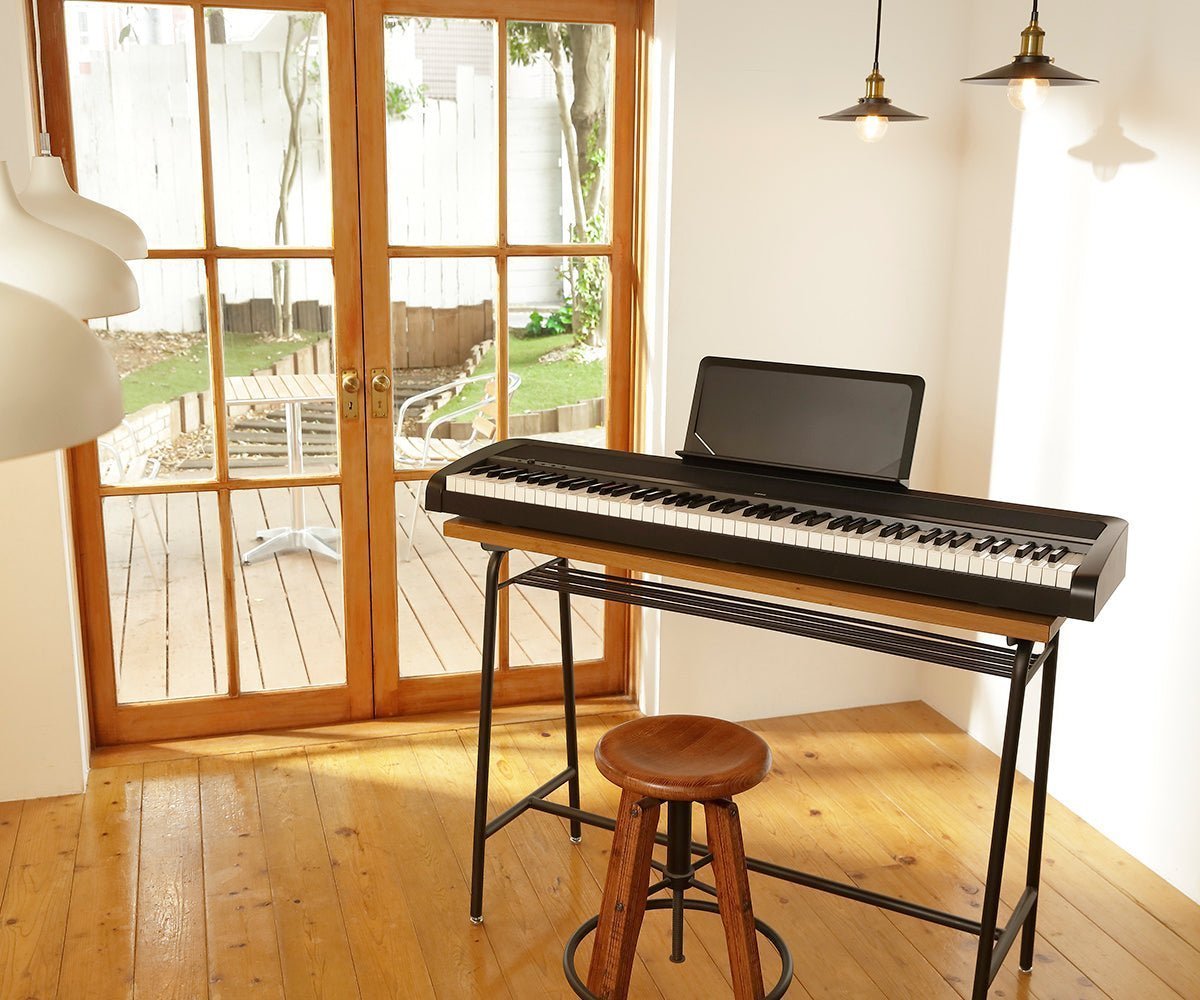
Digital Pianos Under $1000
Discover top digital pianos under $1,000 at Music Planet—like the sleek Korg L1 Liano and feature-rich Casio CTX800. Affordable, stylish, and ready to elevate your music.

Ukulele Buying Guide: How to Choose the Right One for You
From first chords to stage-ready strumming, the ukulele is a joyful companion for any player. At Music Planet, we’ve handpicked top ukuleles for all levels—soprano to tenor, beginner to pro. Explore our guide to find the perfect match for your sound and style.

Studio Synthesizer Buying Guide: How to Choose the Right One for You
From gritty bass to lush soundscapes, synthesizers shape the sound of modern music. At Music Planet, we’ll help you find the right synth for your style, whether you're just starting out or deep into sound design. Explore our guide and unlock your creative potential.
Frequently Asked Questions
Have a Question? We’ve Got the Answer!