
Beginner's Guide to Music Keyboards
Here at Music Planet, we have a huge variety of Keyboards & Digital Pianos.
Welcome to the fascinating world of keyboards! As you embark on this journey of learning, you'll discover that the keyboard is not just a mere peripheral device, but rather an essential tool that bridges the gap between human thought and the digital world. Whether you're composing a symphony, learning how to play chopsticks, or even discovering a brand new note your journey starts with this marvellous device. This article aims to demystify the keyboard and equip you with the knowledge to navigate it confidently. So, let's dive in and explore everything there is to know about keyboards!
What is a Music Keyboard?
A music keyboard, often simply referred to as a keyboard, is a versatile instrument that uses an arrangement of keys to play notes and produce music. It is similar to a piano, but unlike traditional pianos, keyboards are digital and can replicate a wide variety of sounds and instruments. They come in varying sizes, typically with 25, 49, 61, 76, or 88 keys. The larger the keyboard, the wider the range of notes that can be played. Keyboards are popular due to their portability and accessibility for beginners, making them a great starting point for those new to music.
What is the main difference between a keyboard and a Piano?
The main difference between a keyboard and a piano is that keyboards are digital, while pianos are acoustic. This means that keyboards produce sound electronically, while pianos produce sound through the vibration of strings. Additionally, keyboards can offer much more range in terms of tones and voices than a piano, as well as MIDI capabilities that provide you with access to different instrument sounds.
Types of Music Keyboards
There are several types of music keyboards available, each with its unique features and benefits:
Synthesiser
This type of keyboard is designed to generate and manipulate a wide range of sounds using oscillators and filters. Synthesisers are popular in electronic music genres because they provide an extensive palette of sound.
Digital Piano
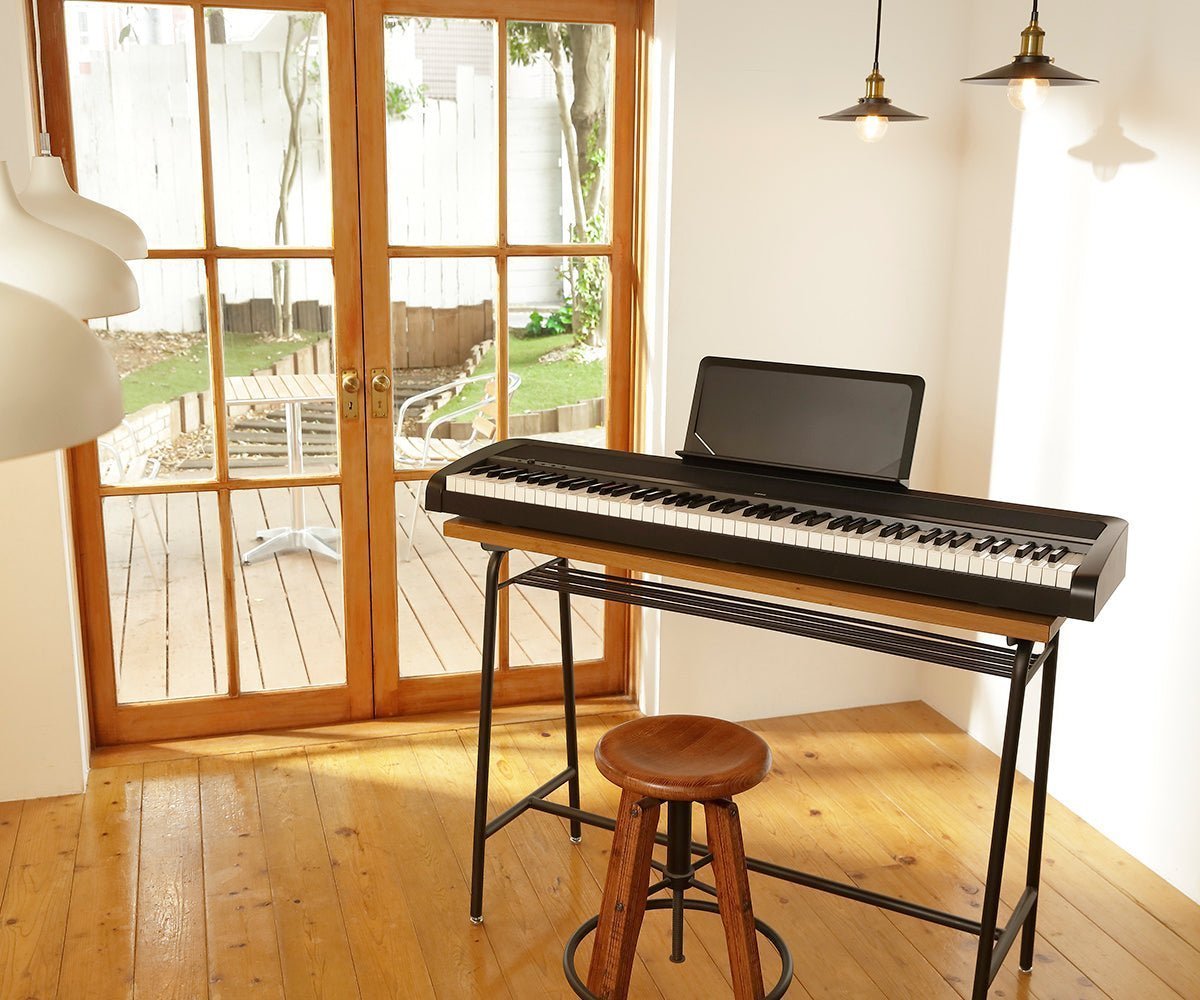
These are designed to replicate the sound and feel of an acoustic piano. They often have weighted keys to mimic the resistance and rebound of a traditional piano.
MIDI Keyboard
MIDI stands for Musical Instrument Digital Interface. These keyboards don't produce sound on their own; instead, they trigger sounds from a computer or another MIDI-enabled device.
Workstation
A workstation keyboard is a multi-faceted instrument having a sound module, sequencer, and controller. This all-in-one solution is perfect for composers and producers as it allows for creating and arranging complex pieces of music.
Arranger
Arranger keyboards come preloaded with accompaniment styles and song templates, making them ideal for songwriters and performers.
Remember, the best keyboard for you depends on your individual needs and musical goals
Choosing the Right Keyboard for You
For beginners, a Digital Piano or a basic Arranger Keyboard can often be the best choice. Digital pianos replicate the feel and sound of an acoustic piano, which is beneficial for those who are interested in classical music and want to eventually transition to a traditional piano. They have weighted keys that provide the resistance and rebound similar to a piano, making it an excellent choice for beginners to develop correct finger techniques and dynamics.
On the other hand, arranger keyboards come with preloaded accompaniment styles and song templates, which can be helpful for beginners as they start to learn about different rhythms, styles, and song structures. However, it's important to remember that the best keyboard for any beginner will depend on their individual preferences, the style of music they wish to play, and the amount of time they can dedicate to practice.
What to consider when buying your first keyboard?
Choosing a music keyboard can feel daunting due to the numerous options available on the market. However, keeping a few key factors in mind can help guide your decision:
- Skill Level
As a beginner, you won't need many of the complex features found on higher-end models designed for professionals. Look for a simple, user-friendly design that will allow you to focus on learning the basics. - Budget
Keyboards range dramatically in price. Determine how much you're willing and able to spend before you start shopping to narrow down your options. - Key Count
As mentioned earlier, keyboards come in various sizes. Beginners can start with a smaller keyboard (25 to 49 keys), while more serious or advanced players might prefer a full-size keyboard (88 keys). - Sounds and Features
Think about the type of music you want to play. If you're interested in classical music, a digital piano with realistic piano sounds might be the best choice. If you want to experiment with different sounds, a synthesiser or arranger might be more suitable. - Portability
If you plan to carry your keyboard to lessons or performances, consider a smaller, lightweight model. - Connectivity
If you want to record your music or use music software, you might need a keyboard with USB or MIDI connectivity.
Remember, there is no one-size-fits-all when it comes to choosing a keyboard. The best keyboard for you is one that suits your needs and helps you achieve your musical goals.
Essential Keyboard Accessories
In addition to the keyboard itself, there are several accessories that can enhance your playing experience and help you make the most of your new instrument:
Adjustable Keyboard Stand
This provides a stable base for your keyboard. An adjustable stand is beneficial as it allows you to set the height to your liking, ensuring you can play comfortably.
Sustain Pedal
A sustain pedal allows you to hold (or 'sustain') notes for longer durations, a feature commonly used in piano music. This accessory can substantially improve the expressiveness of your play.
Keyboard Bench
A comfortable bench can make long practice sessions much more bearable. Like the keyboard stand, look for an adjustable bench to ensure it can be set at the most comfortable height for you.
Keyboard Amplifier
While many keyboards come with built-in speakers, a dedicated amplifier can greatly improve the sound quality, especially when playing for an audience.
Headphones
A good pair of headphones is essential for private practice sessions, enabling you to play without disturbing others around you.
Keyboard Cover
A keyboard cover protects your instrument from dust and other potential damage, helping to prolong its lifespan.
Keyboard Bag/Case
If you plan on travelling with your keyboard, a good-quality bag or case is a must to protect your instrument during transit.
Remember, while all of these accessories can aid your musical journey, not all of them are required right away. As you progress and become more comfortable with the keyboard, you can gradually add these accessories to enhance your playing experience.
Keyboard Functions and Controls
Keyboards come with a variety of functions and controls that enhance the music-making experience, offering the ability to manipulate the sound output and access diverse instrumental sounds:
- Volume Control: This adjusts the loudness of the sound produced by the keyboard. Some keyboards also provide separate control for accompaniment volume.
- Tempo Control: This adjusts the speed of the beat or rhythm, particularly useful when using the auto-accompaniment feature.
- Metronome: This function helps maintain a steady beat while playing – an essential tool for developing rhythmic skills.
- Auto-Accompaniment: This function automatically provides backing tracks that match the chords you play.
- Voice or Tone Selection: This control allows you to select different instrumental sounds, such as piano, organ, violin, flute, etc.
- Transposition: This function changes the pitch of the entire keyboard up or down in semitones, helpful when adjusting a song to a different key.
- Effects Controls: These controls add sound effects to the tones, such as reverb (echo) or chorus (enhanced richness and depth).
- Recording and Playback: These functions allow you to record your performances and play them back – an excellent feature for reviewing your practice sessions.
- Recording and Playback: These functions allow you to record your performances and play them back – an excellent feature for reviewing your practice sessions.
Understanding these functions and controls is key to fully realising the potential of your keyboard and enhancing your playing experience. It provides a whole new level of diversity in sound and a wide array of creative possibilities.
Learning how to play a keyboard
Learning to play the keyboard is a thrilling journey that may seem intimidating initially, but with patience and consistent practice, you'll soon find yourself playing your favourite tunes. Here are some steps to guide you on your musical journey:
Step 1: Familiarise Yourself with the Keyboard Layout: The first step in learning to play the keyboard is understanding the layout. Observe the grouping of black and white keys and understand that each key corresponds to a different note.
Step 2: Learn the Basics of Music Theory: Having a basic knowledge of music theory, such as understanding notes, chords, scales, and tempo, is extremely helpful in playing and interpreting music.
Step 3: Start with Simple Songs: Begin with simple songs that consist of a few notes. This practice will help you get comfortable with the keyboard and improve your finger coordination. As your skill level increases, you can move on to more complex pieces.
Step 4: Practise Regularly: Consistent practice is key to improving your keyboard skills. Try to set aside time each day to practise and make sure to incorporate a variety of exercises, including scales, chord progressions, and song pieces.
Step 5: Use Available Resources: There are countless resources available to help you learn the keyboard. From online tutorials and apps to traditional music books, utilise what best suits your learning style.
Step 6: Consider Professional Lessons: If you're struggling to learn on your own, consider professional music lessons. A teacher can provide personalised guidance and feedback, helping you to improve more quickly.
Above all, remember that learning to play the keyboard should be an enjoyable process. Don't be too hard on yourself if you make mistakes. With time and persistence, you'll see your hard work pay off.
Understanding Keyboard Layout
Getting familiar with the layout of the keyboard is a fundamental step in learning how to play.
Keyboards typically have a pattern of white and black keys which represent different musical notes.
- White Keys: Represent the musical notes A, B, C, D, E, F and G. These notes are the "natural" notes on the keyboard.
- Black Keys: Alternating between groups of two and three, black keys represent the sharp (#) and flat (b) notes. A sharp is a half step higher than the note it follows, and a flat is a half step lower. For instance, the black key right after the C key is C#, and the one right before D is Db.
The pattern of two and three black keys repeats across the entire keyboard. This repeating pattern is helpful when learning to identify the keys and their corresponding notes.
Moreover, keyboards often have more than one set of the same pattern of keys. These are called octaves. A standard full-size keyboard has 7 octaves plus a few extra notes on either end. Each octave begins on C and ends on B.
Understanding the keyboard layout is the first step toward reading music and playing songs. By familiarising yourself with the pattern and octaves, you can start to play simple melodies and gradually move on to more complex pieces.
Hand Position and Posture
Good hand position and posture are vital for playing the keyboard effectively and comfortably. When sitting at the keyboard, your body should be centred on middle C. The height of your bench should be adjusted so that your forearms are parallel to the floor when playing. Avoid having your wrists either drooping down or raised too high - both could lead to discomfort and potential injury over time. Your fingers should be curved, relaxed but firm, and your thumbs should be aligned with the white keys.
As for posture, sit on the front half of the bench, maintaining an upright but relaxed position. Your back should be straight, and your feet should be flat on the floor or on a footrest. Your elbows should be at your sides, creating a roughly 90-degree angle at the elbow when you're playing. Remember to refrain from stiffening up or slouching. Regular breaks are also a crucial part of maintaining good posture, as they prevent muscle fatigue and encourage relaxation.
Learning proper hand position and posture from the beginning will help you avoid unnecessary tension and facilitate efficient and effective keyboard playing.
Finger Numbers and Basic Fingerings
Each finger on both hands is assigned a specific number when it comes to playing the keyboard:
- Thumb: The thumbs are always number 1.
- Index Finger: The index fingers are number 2.
- Middle Finger: The middle fingers are number 3.
- Ring Finger: The ring fingers are number 4.
- Pinky Finger: The pinky fingers are number 5.
When you begin to learn a new piece of music, you'll often see these finger numbers indicated above or below the notes. They serve as a guide to help you know which finger to use when playing a particular note, and they play a crucial role in enabling smooth and efficient movement across the keyboard.
In terms of basic fingerings, one common pattern for beginners is the five-finger scale. Starting with thumb (1) on C and ending with pinky finger (5) on G, the pattern is 1-2-3-4-5. The same pattern applies to the left hand but in reverse, starting with the pinky finger (5) on G and ending with the thumb (1) on C.
Mastering finger numbers and basic fingerings will enable you to navigate the keyboard with more confidence and ease, setting a strong foundation for more advanced techniques as your skills develop.
People Also Read
Digital Pianos Under $1000
Discover top digital pianos under $1,000 at Music Planet—like the sleek Korg L1 Liano and feature-rich Casio CTX800. Affordable, stylish, and ready to elevate your music.

Ukulele Buying Guide: How to Choose the Right One for You
From first chords to stage-ready strumming, the ukulele is a joyful companion for any player. At Music Planet, we’ve handpicked top ukuleles for all levels—soprano to tenor, beginner to pro. Explore our guide to find the perfect match for your sound and style.
Frequently Asked Questions
Have a Question? We’ve Got the Answer!